


A paid advert, a recommendation or a social media post can put your business in front of a potential customer quickly. What happens next depends on where you send them. The landing page versus website decision is not about choosing the more fashionable option. It is about giving that person the right information, in the right order, with a clear reason to get in touch.
For many sole traders and entrepreneurs, the answer is not strictly one or the other. A landing page and a website do different jobs. Knowing the difference helps you spend your budget where it will make the biggest commercial difference.
What is a landing page?
A landing page is a focused web page built around one action. That action might be requesting a quote, booking a consultation, downloading a guide, joining a waiting list or calling your business.
Unlike a standard website page, it usually removes distractions. There may be no large navigation menu, no long list of services and no invitation to browse elsewhere. The visitor sees a direct message that matches the reason they clicked, followed by a clear next step.
Imagine a Manchester electrician running a Google Ads campaign for emergency call-outs. Sending people to a page that says "Emergency electrician in Manchester" with availability, reassurance, reviews and a prominent call button is likely to work better than sending them to a general homepage covering rewires, lighting, inspections and commercial work.
That focus is the landing page's strength. It can make a campaign easier to measure because you can see whether visitors complete the single action it was designed for.
What is a website?
A website is your business's wider online presence. It gives prospective customers room to understand who you are, what you offer, where you work and why they should trust you.
A professional small-business website commonly includes a homepage, service pages, an about page, customer testimonials, contact details and useful local or sector-specific information. Some businesses also need galleries, case studies, booking information, pricing guidance or frequently asked questions.
People rarely arrive with exactly the same question. One visitor may want proof of experience. Another may need to check whether you cover their area. A third may be comparing providers before making contact. A website supports these different journeys without forcing every visitor through the same message.
For a consultant, tradesperson, coach or creative professional, this matters. A strong website does more than collect leads. It shows that the business is established, considered and ready to work with customers.
Landing page versus website: the practical difference
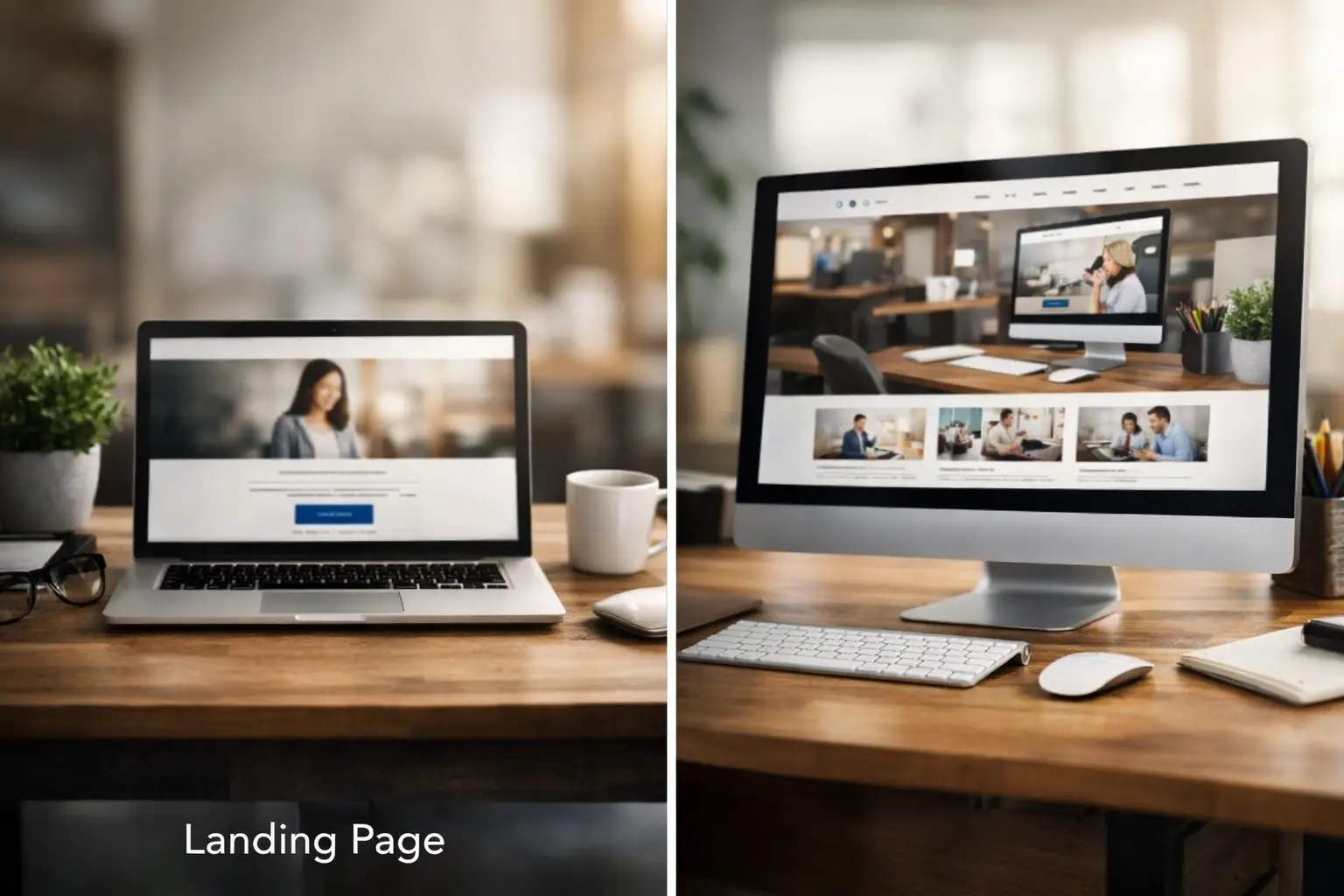
The simplest distinction is purpose. A landing page is designed to convert a specific source of traffic into one specific action. A website is designed to represent your business properly across many customer needs.
That does not mean a landing page is always shorter or a website is always broader. The difference is intent. A landing page speaks to a defined offer and audience. A website builds confidence over time and answers the questions customers ask before they enquire.
A landing page might promote a fixed-price boiler service, a spring garden clearance or a new client consultation. The copy, images and call to action all support that one offer. If someone is ready to act, this direct route can reduce hesitation.
A website is better suited to the bigger picture. It can explain the full range of services, show completed work, introduce the people behind the business and give search engines more useful context about what you do. This is particularly valuable if your customers find you through organic search, referrals or repeat visits rather than a single campaign.
When a landing page is the better choice
Choose a landing page when you have one offer, one campaign and one outcome in mind. It is particularly useful when you are paying for traffic and want every pound to lead visitors towards an enquiry.
A landing page can be a good fit if you are launching a course, promoting a limited service, testing demand in a new area or advertising a time-sensitive offer. It also works well where the visitor already has a clear need, such as an urgent repair or a booked consultation.
The trade-off is that a landing page can feel thin when someone wants to investigate further. If they cannot find evidence of your experience, wider services or contact details beyond a form, they may leave to search for a more established-looking competitor.
For that reason, a landing page works best when it is supported by a credible main website. The campaign page gets to the point. Your website provides the reassurance for visitors who need it.
When your business needs a website first
If you have no proper online home, build the website first. Before spending heavily on advertising, make sure people can find clear answers about your business after they search your name.
This is especially true for service businesses where trust carries real weight. A homeowner choosing a builder, a founder hiring a consultant or a client selecting a photographer may take time to compare options. They will look at your services, work, testimonials and approach before they commit.
Your website should also come first if you offer several services, work across more than one location or rely on local search visibility. Dedicated pages give customers a clearer route to the information they need. They also prevent your homepage from trying to say everything at once.
A simple, well-structured site is more useful than an overcomplicated one. You do not need every possible feature. You need clear service information, professional presentation, a straightforward way to enquire and enough proof that customers can feel comfortable taking the next step.
Using both without creating more work
For many independent businesses, the strongest approach is a professional website with targeted landing pages added when there is a clear commercial reason.
Your website becomes the foundation. It explains the business, supports credibility and gives customers several routes to contact you. Then, when you run a focused promotion, you create a landing page that matches the advert, email or social post exactly.
For example, an accountant's website may cover bookkeeping, tax returns and business advice. During self-assessment season, a dedicated landing page for tax return support can speak directly to the immediate concern. The visitor sees relevant deadlines, the service process and one clear enquiry route, while the wider website remains available for anyone who wants to check credentials or explore other services.
This approach avoids a common mistake: changing your whole website every time you want to promote one offer. Campaigns can stay focused without making your core site confusing.
Questions to ask before you decide
Start with the source of your visitors. If you are sending traffic from a specific advert or promotion, a landing page may improve relevance. If people are searching for your business, comparing local providers or arriving through recommendations, they are more likely to need a full website.
Then consider the decision your customer is making. Low-commitment actions, such as claiming a free estimate or booking a short call, can suit a landing page. Higher-value or more personal services often require the reassurance of a website with supporting detail.
Finally, be honest about what is missing. If your current site looks dated, does not work well on mobile or fails to explain your offer, another campaign page will not solve the underlying problem. Improve the foundation first.
Make the next step obvious
Whether you choose a landing page, a website or both, the principle is the same: a visitor should not have to work out what to do next. Tell them how to enquire, what happens after they contact you and why doing so is worthwhile.
Clear headings, useful service descriptions, genuine testimonials and visible contact options do more for conversion than clever design alone. A professional website should make your business easier to choose, not harder to understand.
At WEBSOS, the first website draft is delivered within seven days, giving busy business owners something real to review without a drawn-out process. The priority is not adding pages for the sake of it. It is creating the right online route for the customers you want to win.
Choose the format that matches your immediate goal, but do not lose sight of the customer behind the click. If they can quickly see what you do, why they can trust you and how to take action, your digital presence is doing its job.