


A website should make it easier for a potential customer to trust you, understand what you do and get in touch. That is why the choice between template sites versus custom websites is not simply about appearance. It affects how quickly you can launch, how clearly you can present your services and how much work the website creates for you later.
For a sole trader or growing business, neither option is automatically right. A template can be a sensible starting point. A custom website can be a stronger long-term investment. The best decision comes down to your commercial priorities, not which route sounds more impressive.
Template sites versus custom websites: the key difference
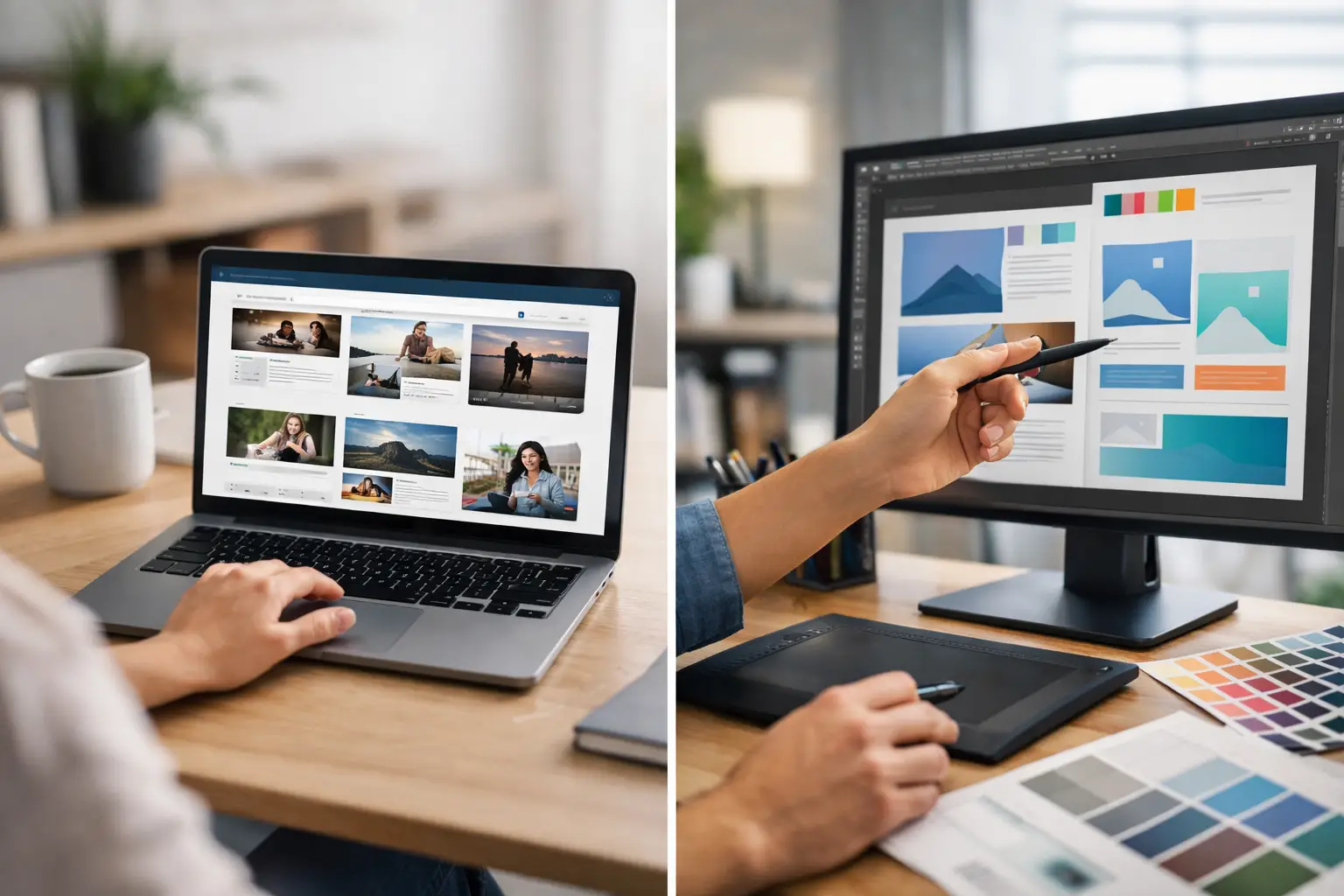
A template site starts with a pre-designed layout. You select a style, add your logo, colours, images and wording, then publish it using a website builder or content management platform. The underlying structure already exists, so the job is mainly one of configuration and content.
A custom website is designed around your business, services, customers and goals. It does not always mean building every part from scratch. In practical terms, it means the layout, page structure, messaging and user journey are shaped to fit your business rather than forcing your business into a fixed layout.
That distinction matters when a visitor arrives with a question: “Can this business help me?” A good website answers quickly. The route you choose affects how well it can do that.
When a template site is a sensible choice
Template sites are popular for good reasons. They can be affordable, quick to get online and straightforward to update once you have learned the platform. If you are testing a new idea, setting up a simple portfolio or need a basic holding presence while your business takes shape, a template may be enough.
They work best when your needs are uncomplicated. For example, you may only need a homepage, an about page, a clear list of services and a contact form. If you have strong images, concise copy and a service that customers already understand, a well-chosen template can look professional.
The issue is not that templates are inherently poor. Many are clean, modern and mobile-friendly. The issue is that they are built to suit a large number of businesses. You may find that the sections do not quite match your offer, the page hierarchy feels generic or important information has nowhere natural to sit.
A template also puts more of the decision-making on you. You need to choose the right layout, write the content, select imagery, adapt the design and judge whether the finished site looks credible. For business owners who are already managing clients, quotes, accounts and delivery, that can turn a supposedly quick project into one that stays unfinished for months.
Where template sites can hold a business back
The biggest limitation of a template is usually not visual. It is strategic. A template often encourages you to fill in boxes rather than decide what a customer needs to see first.
A local tradesperson, consultant, coach and creative professional may all offer services, but they need different website journeys. A visitor looking for an emergency repair needs reassurance, service areas and a fast contact route. A consultant may need to establish expertise, explain a process and demonstrate the value of a conversation. A template may accommodate both, but it will not naturally prioritise what matters most to each audience.
Generic layouts can also make businesses look interchangeable. When several competitors use similar page structures, stock images and headline formats, customers have little reason to remember one over another. This is especially unhelpful if your work is high quality but your website does not communicate that standard.
There can be practical limits too. Adding booking tools, enquiry flows, case studies, multiple service areas or specific content sections may become awkward. It is possible to keep adding workarounds, but a site can soon feel cluttered and harder to manage.
What a custom website gives you
A custom website gives your business room to lead with what makes it credible. Rather than beginning with a preset design, the work begins with questions such as who you want to attract, what they need to know and what action you want them to take.
For many independent businesses, this means making services easier to understand. It could mean separating two distinct customer types, presenting specialist work clearly or giving testimonials and project examples more prominence. These are not decorative choices. They help visitors decide whether to enquire.
Custom design also allows for a more considered visual identity. Your colours, type, photography and page layouts can support the character of your business without becoming over-designed. A reliable local operator may need a direct, reassuring feel. A creative studio may need more visual space. A professional adviser may need clarity and authority above everything else.
The outcome should still be simple. A custom website is not valuable because it has unusual effects or complicated features. It is valuable when it removes friction for your customers and represents your business properly.
Speed is not only about launch day
It is easy to assume templates are always faster and custom websites are always slower. That is sometimes true, particularly if a custom project has a vague brief, too many stakeholders or an agency process built for large organisations.
But a clear, productised website service can change that equation. When the process is focused, a professional custom build does not need to mean waiting months to see progress. At WEBSOS, clients receive a first website draft within seven days, giving them something real to review while the project is still moving.
This matters because the faster route is not always the one with the fewest clicks. If you spend evenings adjusting a template, second-guessing each section and rewriting pages repeatedly, the true cost is your time and lost momentum. A structured custom process can be faster in the sense that it gets you to a usable, credible result sooner.
Compare the real cost, not the starting price
A template may have a lower initial cost, especially if you build it yourself. That can be the right financial choice when cash flow is tight and your needs are genuinely basic. However, it is worth accounting for the full picture: your time, platform fees, paid add-ons, professional images, copywriting help and future redesign work.
Custom websites usually cost more upfront because design and planning are included. The return comes from a site that is built around your offer, with a clearer path to enquiries and fewer compromises from the start.
There is no universal point at which a custom site becomes necessary. A new side business may be well served by a template. An established sole trader with a steady flow of referrals, a higher-value service or an outdated site that no longer reflects their work will often benefit from a more tailored approach.
The useful question is not, “What is the cheapest website?” It is, “What website will help the business I am trying to build?”
Choose based on your next 12 months
Think about where your business is heading rather than only what it needs this week. If you are likely to add services, target a more specific type of customer, build a portfolio or run marketing campaigns, your site needs a structure that can support those plans.
A custom build makes particular sense when your offer is difficult to explain in one sentence, your reputation is central to winning work or your existing website is causing hesitation. It is also useful when you want someone else to guide the process, rather than handing you a tool and leaving you to work it out.
A template remains a good option when simplicity is genuinely the goal and you are comfortable taking ownership of the setup. Choose a clean design, avoid trying to use every available section and focus on clear service information and an obvious contact route. A smaller site that is finished and useful is better than a grander plan that never goes live.
Your website does not need to impress every person who sees it. It needs to give the right customers enough confidence to take the next step. Choose the route that lets you do that promptly, clearly and at a standard that matches the work you deliver.