


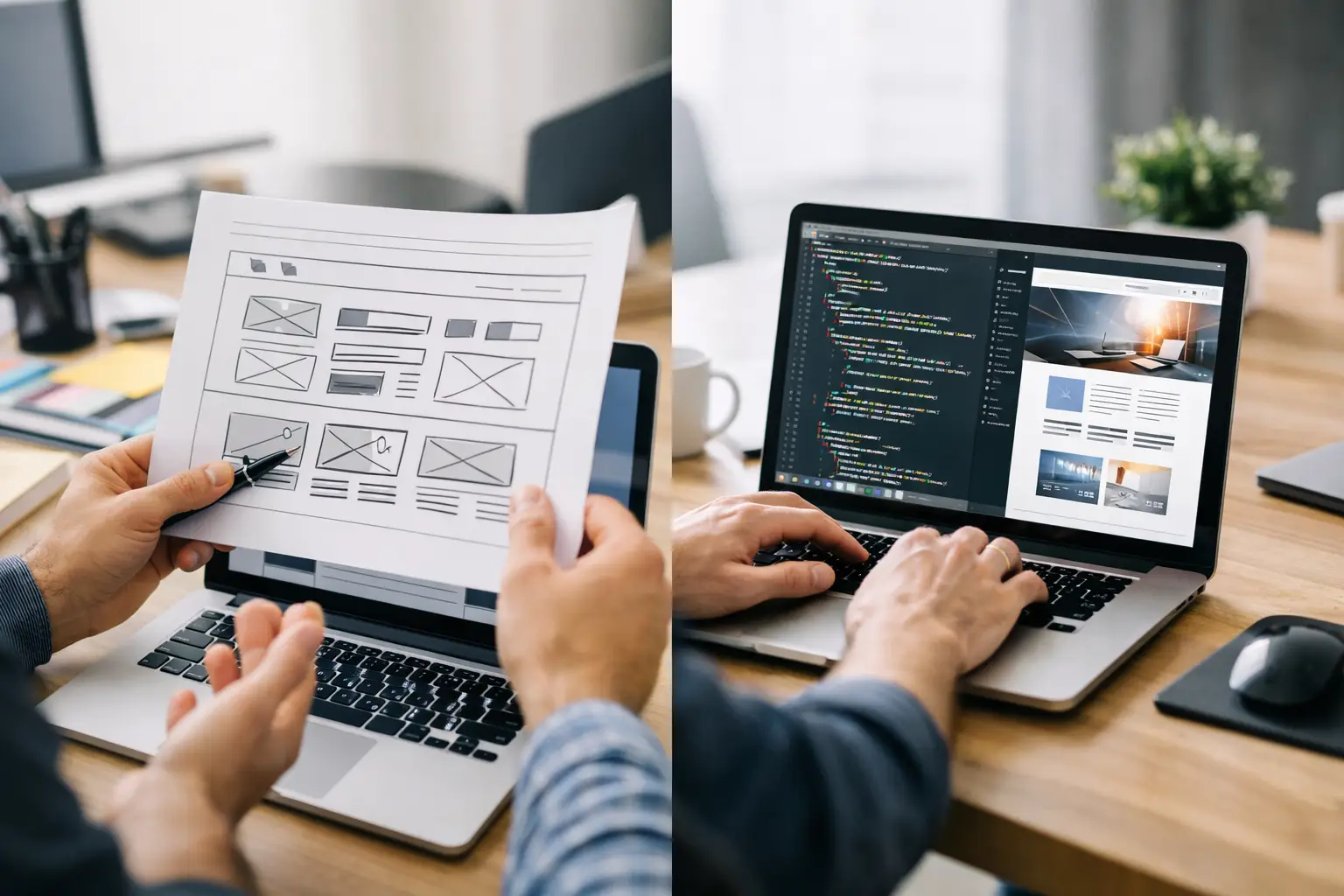
Your website may still have your correct phone number, services and logo, yet be costing you enquiries. Slow pages, unclear messaging, dated visuals and a poor mobile experience can make a capable business look less established than it is. The decision between website redesign versus rebuild is therefore not about changing colours for the sake of it. It is about choosing the quickest, most sensible route to a website that earns trust and helps customers take action.
For a sole trader or growing business, the right answer depends on what is underneath the current site as much as what appears on screen. A redesign can be efficient when the foundations are sound. A rebuild is often better when those foundations are holding the business back.
What a website redesign actually changes
A website redesign improves the presentation and user experience of an existing site while retaining much of its current structure or platform. It may involve a new visual style, clearer page layouts, better calls to action, updated copy and improved mobile formatting.
This route is usually appropriate when your website already contains the essentials: the right pages, a workable content management system and a structure that search engines can understand. Perhaps your services have not changed, but the site looks several years behind your competitors. Or perhaps visitors can find what they need, but the journey feels untidy and does not encourage them to get in touch.
A focused redesign can make a real commercial difference. Stronger headings help visitors understand what you offer within seconds. Clearer service pages reduce the number of questions potential customers need answered before contacting you. Better placement of enquiry buttons can turn passive browsing into useful leads.
The main advantage is speed. There is less to plan, less content to move and fewer technical decisions to make. If the existing site is genuinely fit for purpose, improving it rather than starting again can protect your budget and get results sooner.
That said, a redesign has limits. A polished homepage cannot solve a confusing site structure, unreliable software or a platform that makes every update difficult. It can also be false economy to spend time styling a website that needs replacing soon afterwards.
When a website rebuild is the better investment
A website rebuild means creating the site again from the ground up. The pages, structure, design and technical setup are reviewed as a whole rather than treated as fixed. You retain the useful parts of your business story, but you are not constrained by an old website's layout or limitations.
A rebuild makes sense if your current site was built on an outdated system, performs poorly on mobile, is difficult to update or no longer reflects how your business operates. It is also the stronger option when your offer has changed significantly. A consultant adding new services, a tradesperson expanding into new areas, or a founder moving from freelance work to a larger operation may need a clearer structure than their original site can support.
It is worth rebuilding if customers regularly struggle to find basic information, such as pricing guidance, service areas, availability or how to make an enquiry. The issue is not simply design. It is that the website is failing to guide visitors towards a decision.
A rebuild gives you the opportunity to simplify. Many small-business websites have accumulated unnecessary pages, duplicated content and old offers over time. Starting with the customer journey helps you decide what must stay, what needs rewriting and what can be removed. The result is often a smaller, clearer website that works harder.
The trade-off is that a rebuild requires more early decisions. You need to be clear about your audience, services, priorities and the actions you want visitors to take. However, this does not need to become a drawn-out agency process. With a structured brief and a focused scope, a new site can move quickly from idea to a useful first draft.
Website redesign versus rebuild: the practical test
Before choosing, assess your existing website honestly. The question is not whether you are tired of looking at it. The question is whether it can support the business you are trying to build.
A redesign is likely enough when the site is technically reliable, easy to manage and built around sensible pages, but its appearance and messaging are weak. If visitors can access it easily on their phones, forms work properly and the platform does not create problems, there may be no need to throw away good foundations.
A rebuild is more likely when several core problems exist at once. For example, the site may load slowly, look poor on mobile, use an awkward page structure, contain outdated services and make edits frustrating. Fixing each issue separately can take more time and money than building a clean replacement.
Consider the following four areas together:
- Your business offer: Does the site explain what you sell now, rather than what you sold two years ago?
- Customer confidence: Does it look professional enough for the value of your work and the price you charge?
- Ease of enquiry: Can a potential customer quickly understand the next step and contact you without effort?
- Technical practicality: Can you update the site, view it properly on a mobile and rely on its key functions?
One weak area may call for a redesign. Persistent problems across all four point towards a rebuild.
Do not let existing content make the decision for you
Business owners often avoid a rebuild because they are worried about losing pages, Google visibility or content they spent time writing. Those are sensible concerns, but they do not mean you should keep an ineffective website.
Useful content can be retained, improved and moved into a better structure. Existing page addresses can be managed carefully so visitors and search engines are directed to relevant new pages. More importantly, a rebuild gives you the chance to improve thin or unfocused copy before it is carried forward.
Keeping every old page is rarely the goal. A visitor does not need a long history of discontinued services or several pages that say nearly the same thing. They need confidence that you understand their problem and can help them solve it. Quality and clarity matter more than preserving clutter.
Put business outcomes before design preferences
It is easy for a website project to become centred on fonts, colours and personal taste. Visual quality matters because people make quick judgements online. But the most useful decision is based on what the site needs to achieve.
If your priority is to start generating more enquiries, focus on whether the website clearly presents your services and makes contact straightforward. If you want to move into a more premium market, assess whether the current site supports that position. If you are launching a new offer, ask whether the existing navigation and page structure give it enough space and importance.
A modern website should not make visitors work to understand your business. Your headline should be clear. Your services should be easy to scan. Your proof, such as experience, testimonials or examples of work, should appear where it supports a decision. The route to an enquiry should be obvious on every important page.
How to keep the project moving
Whichever route you choose, progress comes from a defined scope. Decide which services need promoting, who you most want to attract and what a successful enquiry looks like. Gather your logo, images, testimonials and any essential business details before the project starts, but do not wait for every small detail to be perfect.
The right delivery partner should make the process feel manageable. You should know what is needed from you, when you will see work and how revisions will be handled. For time-poor entrepreneurs, an early draft matters because it turns a website from an abstract task into something real that can be reviewed and improved.
WEBSOS provides a first website draft within seven days, giving independent businesses a clear point to react to rather than weeks of silence and complicated project language.
A redesign is the smart choice when good foundations need sharper presentation. A rebuild is the smart choice when the foundations themselves are getting in the way. Choose the route that gives customers the clearest reason to trust you and the easiest way to contact you - then get it moving.